Scarlet Skips Beginner Guide: Timing, Tips & First Runs
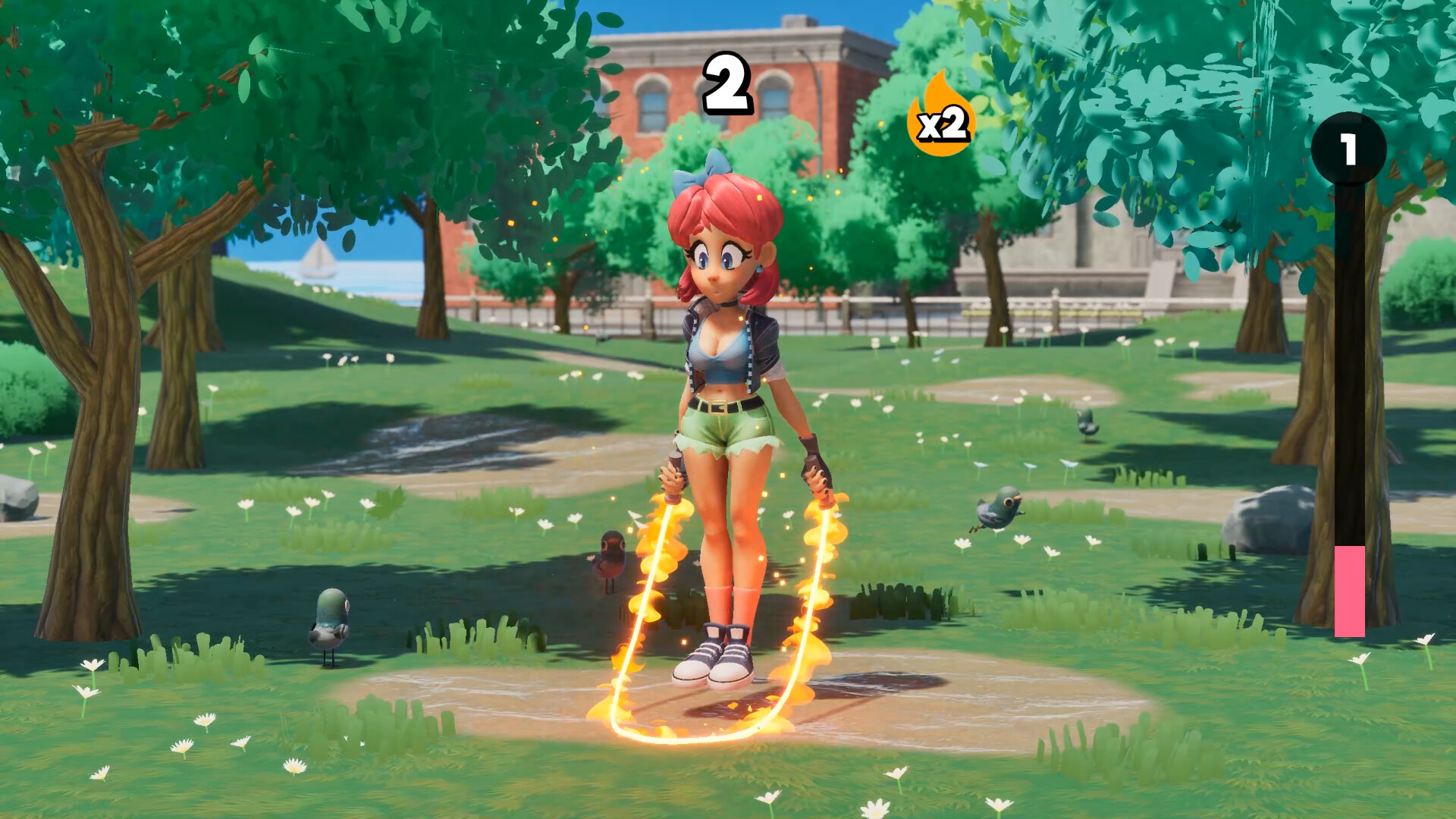
The fastest way to get good at Scarlet Skips is to learn the timing of a single skip before you start stacking cards: new players improve fastest by nailing the rhythm of each jump first, then letting level-up upgrades carry the later parts of a run. Play your first runs to read the rope and press one button deliberately, and you will survive longer, see more level-ups, and reach the upgrade choices that keep a run alive.
How a run works
Scarlet Skips is not a map, a dungeon, or a party RPG. You load in, Scarlet starts skipping, and the whole session is: stay on the rope while power-ups rewrite the jump. Official copy frames it as helping Scarlet break out of a funk by touching grass; the playable version is keep jumping.
A typical first run has four beats. You find the timing. You survive long enough for a level-up, which shows three random power-ups from a pool of about 10 upgrade cards, and you pick one. Then the next minute feels different enough that your old timing no longer works. That is the roguelike half. The arcade half is that missing the rope ends the attempt and locks in your score.
| Fact | Detail |
|---|---|
| Release | September 3, 2026, by Yerk Games |
| Platform | PC (Steam), Steam Deck Verified |
| Price | $4.99 USD |
| Input | One button: press, hold, release |
| Upgrade pool | 10 cards; 3 shown per level-up |
| Mode | Single-player only |
| Achievements | 1 Steam achievement |
| Reviews (snapshot) | Mostly Positive: 74% of 708 reviews (September 2026 Steam snapshot) |
Do not expect a tutorial dungeon or an open-world checklist. Progress means longer survival, weirder card stacks, a new personal best, or a successful ending attempt. The community splits into "how to play," "how to get a high score," and "how to win" camps, so pick one goal for your first hour. Account-level meta-unlock trees are not listed on the Steam store page, so do not assume a progression board exists until you see one in-game.
The one button: press, hold, release
The control scheme is press, hold, and release on a single input. There is no second button for a dash, a block, or a skill menu mid-skip, and there is no combo list — the skill is timing windows.
- Press starts the jump. Confirm the jump bind from the in-game prompt before your first skip rather than assuming it.
- Hold shapes the jump. Once upgrades change Scarlet's jump height, hold length is what you are really adjusting.
- Release ends the input and lets the arc play out; a release that is late or early shows up as a rope catch.
On keyboard the jump bind is often Space; on a pad it is usually a face button. Steam Deck Verified means the default controls should show the correct glyphs. If an external Bluetooth pad feels dead, switch the active controller in the Quick Access Menu — confirm that in your session before assuming a bug.
Diagnosing your own misses
Hold length matters more than click speed, and it matters even more once cards change jump height:
- A short tap that worked at the start can clip a faster rope later.
- If Scarlet sails over the rope with leftover air time, you are holding too long for the new height.
- If she eats the rope on the way up, you released late or started late.
Use those three sentences as your miss log: most early failures are one of these, not the game cheating.
Reading the rope
Watch the rope, not a fixed metronome. Scarlet's trailer-style animation is expressive on purpose — her body language is a readability feature and a distraction at the same time. Watch the rope first and the joke second.
The timing window is not static. Rope speed changes, extra ropes add objects to track, and height upgrades change when you should leave the ground, so a rhythm that worked a minute ago is no promise. A second rope means following more than one moving object — exactly where new runs die.
Player footage shows some players fixing their eyes on one spot where the rope passes and reacting as it arrives there, instead of scanning the whole scene. Unconfirmed: player-reported rather than a documented setting, but it matches the official advice to watch the rope itself.
If the rope seems to "cheat," check your display before blaming the card pool: input lag on a TV, a high-refresh desktop, or a docked Steam Deck shifts how the rope reads versus a windowed session on a PC monitor.
Common first-run mistakes
- Chasing flashy cards before the beat. Fire ropes and extra ropes look like the trailer, but they ask you to track more than one moving object. A first-run player who takes every flashy card will spend the session relearning the button instead of the beat.
- Treating every stack as good. The store says card stacks combine into "virtually infinite" configurations — true as a combinatorics boast, not as a promise that every mix helps a new player.
- Panicking after an early death. If you died on your very first jump, that can be the joke achievement path, not a broken bind. If you died later, work the miss log above before changing settings.
- Mashing instead of learning. There is no speed requirement here; press, hold, and release are all timing decisions, and random mashing never teaches you the window.
Your first upgrade picks
Every level-up offers three random power-ups from a pool of about 10 cards and you keep one. Officially named effects are increasing jump height, adding a jump-rope, and setting the rope on fire. Player footage also shows card titles such as reinforcing the rope, igniting or extinguishing the rope, and increasing luck — the card text in your client is the final authority on what any of them do. Rocket boots and air fuel appear only in community clips; treat them as community-reported until the cards show up in your client.
The goal of a first pick is not power. It is surviving to the next choice.
| If the three cards look like... | New-player pick | Why |
|---|---|---|
| Height vs. extra rope vs. fire | Height | One object to track; teaches hold time |
| Two extra-rope variants + fire | Skip fire if you still miss single ropes | Fire is a read, not a crutch |
| Unknown named cards | The card whose text you can finish reading | Unread cards are random grief |
| Anything that adds a second failure plane | Defer | Survive to the next choice |
At the next two picks, ask whether you are still dying to timing or to clutter. Timing deaths mean simpler cards; clutter deaths mean no more ropes until you can pass the original rhythm again. Full card details and stacking rules are in the upgrades guide.
Getting consistent before chasing scores
Consistency comes before score chasing. New players improve fastest by learning the timing of each skip first, then using upgrades to make later sections of a run easier. Drill: play one run refusing every card that adds a second rope or fire, using only timing plus jump height if it appears, with a target of twenty clean skips in a row — not a clip, not a score.
Three small rules to keep:
- Confirm the jump bind in the in-game prompt before the first skip.
- Play the first stretch with no extra ropes if the game offers them.
- If jump height increases, shorten the hold.
Once twenty clean skips feel ordinary, you are ready to risk an extra rope or a fire pick. From there, the high-score guide covers risk control and run planning for longer attempts.
Quick tips roundup
- Watch the rope, not Scarlet's animation — her body language is the distraction.
- Keep hold length matched to the current jump height; recheck it after every height card.
- Read the full text of a card before picking it. An unread card is random grief.
- Prefer cards that keep one rope and one timing window while you are still missing single skips.
- Confirm the bind and the active controller before your first skip, and test windowed on a monitor if timing feels off.
- Pick one goal for your first hour: learning to play, chasing score, or investigating the ending talk.
Player footage corroborates some card names but not their exact values, so treat specifics like "three ropes is a good amount" or "fire ropes are strong" as player opinions, not documentation.
FAQ
Why did my run end almost immediately?
A timing window you have not learned, a hold that no longer matches jump height, or a second rope you were not watching. If it was literally your first jump, failing it is the game's single joke achievement, "Off to a Great Start," held by roughly three-quarters of players in the first days after launch as of September 2026 — nothing is broken.
Is there anything besides the one button?
No second button exists for dashing, blocking, or menus during a skip. The controls are press, hold, and release; the depth is in the timing.
What do rocket boots and air fuel do?
They appear in community clips, but not among the officially named effects, so their exact behavior is not documented. Unconfirmed: community-reported; the card text in your client is the source of truth.
Is there an ending or a world record system?
No boss, final level, credits, or official leaderboard is documented, and there is no official confirmation of a secret ending or a world-record mode. Players do discuss a win condition, but that remains community talk until the client or the developer confirms it — see the ending explainer for the full picture.
Should I take fire cards early?
Player footage shows fire-rope cards in the pool and at least one player praising them, but for new players fire is a read, not a crutch — skip it while you still miss single ropes.